
Drywall Repair and Replacement in Oviedo, Florida
Most of Oviedo went up between the mid 1990s and the late 2000s, in Alafaya Woods, Twin Rivers, Kingsbridge and the subdivisions that fan out off Lockwood Boulevard, and those houses are now hitting twenty to thirty years old with interior walls that have been touched up piecemeal instead of redone. That means a builder-grade knockdown texture that was never documented, drywall tape joints at door heads starting to telegraph through the paint, and a rental market tied to the UCF calendar that cannot afford a wall to sit half-patched during a turnover week.
The condition that shows up over and over in this age of home is cracking at the corners of doors and windows, usually diagonal, usually where a slab has settled slightly or a header has flexed over two decades of Florida heat cycles. It is cosmetic almost every time, but it comes back fast if it is skim-coated instead of properly taped, mesh-reinforced and feathered out. The other recurring call is ceiling staining in a kid’s bedroom or a hallway under an attic access, left behind by a roof or AC condensate issue that somebody already fixed but never followed up with actual drywall repair.
If you are looking at a crack, a water stain, a hole from a doorknob, or a wall that needs to come down and go back up clean before new paint, here is what the job actually involves in Oviedo’s housing stock and what changes the price.
What drives drywall damage in a 20 to 30 year old Oviedo house
A house built in 1998 or 2004 is old enough for the lumber to have finished settling and the slab to have found its final resting position, which is exactly when corner cracks at door and window headers start showing up. It is also old enough that the original texture was sprayed once, by a crew working off a builder spec, and never matched again. Every patch since has either left a flat scar in a textured wall or used a texture that is close but not quite right under afternoon light coming through a west-facing window.
Add in that a real share of Oviedo’s rental stock turns over every May and August on a UCF schedule, and wear that would sit untouched for years in an owner-occupied house instead gets found, reported and expected to be fixed in a tight window between leases. The drywall work here is less about storm damage and more about two to three decades of normal living finally catching up with walls that were never built to be perfect forever.
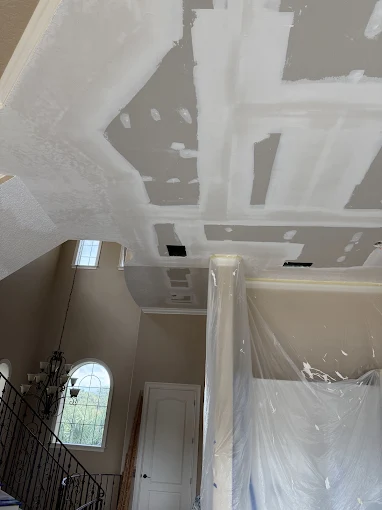
How a repair or replacement job actually goes
Small jobs and full-room jobs both start the same way: look at what is actually failing before cutting anything. A hairline crack at a door header gets treated differently than a soft, crumbling patch near a window sill, which usually means water got in at some point and the drywall underneath is compromised, not just cracked on the surface.
- Assess and cut back to solid material. Soft or water-damaged drywall gets removed past the visible damage, not just at the edge of the stain, because paper-faced gypsum wicks moisture sideways.
- Frame or back the patch. On an interior stud wall this is straightforward. On an exterior wall, Oviedo’s block-and-furring-strip construction means the patch has to be screwed to a furring strip or a added cleat, not just floated with tape, or it flexes and cracks again within a year.
- Tape, coat and feather. Three coats minimum on any seam, each wider than the last, sanded between coats. This is the step most rushed jobs skip and the step that shows up as a visible ridge once paint goes on.
- Texture match. Tested on a scrap or an inconspicuous section first, then sprayed or hand-applied to match the surrounding wall’s pattern and density before it’s allowed to read as a repair instead of a patch.
- Prime and finish paint. New drywall and compound both drink paint differently than the surrounding wall, so this gets a stain-blocking primer coat before topcoat, especially over any area that had water involved.
The price moves at two points: how much of the damaged material has to come out before you hit solid substrate, and whether the texture match is close enough on the first attempt or needs a second pass. A clean hairline crack is a different job than a water-stained ceiling where half the gypsum has to come down.
- Identify what needs to go. Walk through the rooms, garage, attic, shed and other storage areas. Separate unwanted furniture, appliances, boxes and household clutter from belongings you intend to keep. This helps establish the actual scope of the job.
- Assess access and handling. A large item near an accessible entrance may be straightforward to remove. Bulky furniture in an attic, heavy appliances or items stored behind other belongings can require more time. Stairs, narrow doorways, limited parking and longer carrying distances can also affect the work.
- Determine the size of the cleanout. Removing a few items from one room differs from emptying a garage or preparing an entire property for new occupants. The amount of material, the number of areas involved and the type of items all influence the workload.
- Discuss the estimate. Describe the items and areas involved, including any access challenges or unusual handling requirements. Photos can help communicate the scope before an estimate is arranged.
The honest constraint: furring strips change the rules
If you have patched drywall in a stick-built house up north, Oviedo’s exterior walls will surprise you. Most of this city’s pre-2010 housing stock is concrete block with furring strips attached to the block and drywall screwed to the strips, which means there is no open stud cavity behind the wall the way there is in newer stick-frame construction. A patch that would simply screw into a stud sixteen inches away instead has to find a furring strip, or a cleat has to be added to give the new drywall something solid to grab. Skip that step and the patch will flex, the tape joints will telegraph, and you’ll be looking at the same crack again within a year or two. It takes longer and it is not optional on these walls, and anyone proposing to skim over a hole in a block-and-furring wall without addressing what’s behind it is setting the repair up to fail.
What to check before you call
Look at the damage in different light, morning and evening, since texture mismatches that are invisible at noon show up hard under a low side light through a window. Note whether the wall in question is an interior partition or an exterior wall, since that tells you whether furring strips are in play. If there is or was a stain, find out whether the source has actually been fixed, because new drywall over an active leak just delays the same conversation. And if the house is a rental, know the turnover date, since texture matching and paint drying time both need to be scheduled around it, not squeezed into the last 48 hours before a new tenant moves in.
What this covers, and what it doesn't
This is drywall repair and replacement work: patching holes, repairing cracked corners, matching texture, replacing water-damaged sections once the cause is fixed, and full hang-and-finish for a room being opened up as part of a larger renovation. If a wall is coming down or being moved as part of that renovation, or if the damage turns out to trace back to a plumbing or roofing issue that hasn’t been addressed yet, that portion goes to the appropriate licensed trade first. Iron Site Property Services handles the drywall, texture and paint around that work and keeps the schedule moving, which matters most on a rental turnover where every extra day is a day the unit isn’t earning rent.
For anyone weighing this against other work on the property, the full range of property services in Oviedo covers everything from painting to flooring to rental make-readies, which is often useful context if the drywall repair is one piece of a bigger turnover or refresh.
Ceilings with old stains
A water-stained ceiling in a hallway or bedroom closet is one of the most common calls in this age of Oviedo house, usually from a roof issue or an AC line that someone already addressed months or years ago without ever fixing the ceiling itself. Painting over a water stain with regular wall paint almost never works, the tannins bleed back through within weeks. The drywall either gets replaced if it’s soft or delaminating, or it gets a stain-blocking primer if it’s still structurally sound, then texture-matched to the surrounding ceiling and repainted. Before any of that starts, it’s worth confirming the original cause is actually gone and not just dormant.
- Make a list of unwanted items. Identify the furniture, appliances, boxes and other belongings that need to be removed.
- Check each area. Look through the garage, attic, shed, spare rooms and outdoor storage spaces so the full scope is clear.
- Review access. Note stairs, narrow doorways, gates, parking limitations and obstacles between the items and the pickup location.
- Take photos. Pictures of the largest items and each area can help communicate the amount of material involved.
- Identify special handling needs. Mention unusually heavy items, mixed debris or materials that may require separate disposal arrangements.
- Consider the next stage. If the property needs painting, flooring installation, cleaning or repairs after the cleanout, explain your intended schedule.
If you’re looking at a crack, a hole, or a stained ceiling that’s been bothering you since before the last lease turned over, call Iron Site Property Services at (386) 345-2852 for a free estimate. Describe what you’re seeing and whether the wall is interior or exterior, and you’ll get a straight answer on what it takes to fix it right.