
Drywall Repair and Replacement in Longwood, Florida
Longwood has three different housing eras sitting within a few miles of each other, and each one hands you a different drywall problem. The turn-of-the-century frame houses near the Longwood Hotel have real stud cavities and lath-adjacent quirks from decades of additions, while the custom and semi-custom homes built through Sweetwater and Wekiva in the 1970s and early 1980s sit on block with furring strips behind the drywall, and almost none of those original kitchens or ceilings have ever been touched.
That matters because a patch that works on one of those walls does the wrong thing on the other. A repair screwed into a furring strip on a block wall needs different backing than one going into a 16-inch stud bay in a frame house, and a texture match on a ceiling that’s been collecting the shade and humidity of a wooded Wekiva lot for forty years behaves differently than fresh drywall going up in a renovated kitchen. Tell us the age of the house and roughly where the damage is and the approach gets set before anyone shows up with a trowel.
What drives drywall damage in Longwood's older homes
Under the tree canopy that defines Sweetwater, Wekiva and the Springs, the recurring damage isn’t inside the drywall itself, it’s what’s happening around it. Those lots stay shaded most of the day, which means slower drying after rain, more humidity sitting against exterior walls, and cedar or T1-11 siding that rots at the fascia and corners long before anyone notices a problem inside. By the time paint starts lifting or a soft spot shows up near a window header, the substrate behind it is often already compromised, and that’s usually paired with interior drywall damage at the same corner where moisture has been working its way through year after year.
The historic district near the Longwood Hotel has a different driver. Those frame homes have been added onto, re-wired, and re-plumbed multiple times over more than a century, and every one of those projects left a patch, a seam, or a texture mismatch behind. Cracking at door heads and corners in these houses is often old settling rather than active movement, but each crack still needs to be opened, filled properly and matched rather than skimmed over.
How the repair actually goes, and where the cost forks
The first decision point is whether the texture needs testing. Anything built before the mid 1980s, which covers a large share of the Sweetwater and Wekiva stock, gets its existing texture tested before a scraper or sprayer touches it. A negative result means the crew moves straight into the repair. A positive result means the work in that area shifts to a licensed abatement specialist first, and that step happens before anything else regardless of how small the damaged area looks.
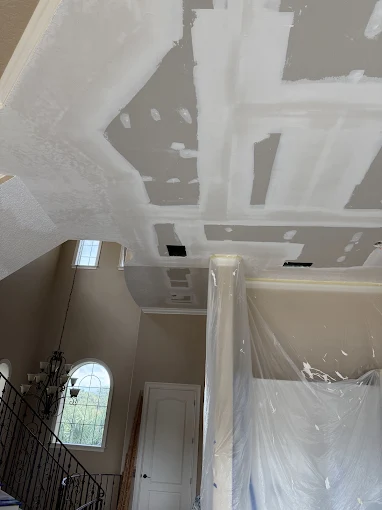
Once that’s settled, the damaged section gets cut back to sound material. On a frame wall in the historic district that usually means cutting to the nearest stud. On a block exterior wall in the newer part of town it means cutting back to a furring strip or adding a backing block behind the patch so the new drywall has something solid to anchor into, since there’s no open cavity to work with the way there would be in a stick-built wall. This is the step that separates a clean, flat repair from one that flexes or cracks again within a year.
From there it’s hang, tape, three coats of mud with drying time between each, texture match, and paint. A single hole in a hallway might only need a day start to finish. A ceiling with water staining from an old leak, once the source of that leak has already been resolved by whoever fixed the plumbing or roofing issue, takes longer because the stained area has to be sealed before new texture goes over it or the stain bleeds back through.
- Identify what needs to go. Walk through the rooms, garage, attic, shed and other storage areas. Separate unwanted furniture, appliances, boxes and household clutter from belongings you intend to keep. This helps establish the actual scope of the job.
- Assess access and handling. A large item near an accessible entrance may be straightforward to remove. Bulky furniture in an attic, heavy appliances or items stored behind other belongings can require more time. Stairs, narrow doorways, limited parking and longer carrying distances can also affect the work.
- Determine the size of the cleanout. Removing a few items from one room differs from emptying a garage or preparing an entire property for new occupants. The amount of material, the number of areas involved and the type of items all influence the workload.
- Discuss the estimate. Describe the items and areas involved, including any access challenges or unusual handling requirements. Photos can help communicate the scope before an estimate is arranged.
The honest constraint
Texture matching on the older Wekiva and Sweetwater homes is slower and more exacting than most people expect, and that’s the part worth planning for. A lot of these ceilings have decades of paint buildup over the original texture, sometimes several coats applied at different times with slightly different sprayers or techniques. Getting a patch to disappear into that means a test section first, and sometimes a second pass once the first has dried, because matching forty-year-old texture under years of repainting isn’t a one-coat job. It’s not difficult work, it’s just not fast, and a quote that skips this step is usually underestimating the job.
What to look at before you call
Walk the damaged area and note whether it’s on an exterior wall, an interior wall, or a ceiling, since that changes what’s behind the drywall and how the patch gets anchored. If it’s a stain, check that whatever caused it, whether a roof leak or a plumbing issue, has actually been fixed, because drywall repair goes back up once but it shouldn’t go up twice. If you’re in one of the older homes near the hotel or out in Wekiva, a rough sense of the home’s age helps the crew know what’s waiting behind the wall before the first cut gets made.
If the project is bigger than a patch, say a renovated kitchen or an addition that needs a full hang and finish, that’s worth looking at alongside the broader drywall repair and replacement scope, since full rooms get bid and scheduled differently than spot repairs.
Where this fits into the rest of the work in town
Drywall repair rarely shows up alone in Longwood. A water-stained ceiling usually comes with a repaint of the whole room so the new patch doesn’t stand out against faded paint around it. A cracked corner near a door often gets noticed during a bigger project, like updating trim or swapping flooring in one of the Sweetwater homes that hasn’t been touched since it was built. If you’re weighing a few different repairs or updates at once, the broader work we do around Longwood covers how those pieces usually get sequenced together.
Permits and what they do not cover
Drywall repair and texture matching don’t require a permit in most cases, whether you’re in Seminole County’s unincorporated areas or inside Longwood’s city limits. That changes if the repair is part of a larger project that moves a wall or alters an opening, and if that’s the case, the licensed contractor handling that portion of the work pulls the permit for it. Patching a hole or re-skimming a ceiling on its own doesn’t trigger that process.
If the drywall work is part of a bigger bathroom update, see bathroom remodeling in Longwood.
- Make a list of unwanted items. Identify the furniture, appliances, boxes and other belongings that need to be removed.
- Check each area. Look through the garage, attic, shed, spare rooms and outdoor storage spaces so the full scope is clear.
- Review access. Note stairs, narrow doorways, gates, parking limitations and obstacles between the items and the pickup location.
- Take photos. Pictures of the largest items and each area can help communicate the amount of material involved.
- Identify special handling needs. Mention unusually heavy items, mixed debris or materials that may require separate disposal arrangements.
- Consider the next stage. If the property needs painting, flooring installation, cleaning or repairs after the cleanout, explain your intended schedule.
Send a few photos of the damage and the rough age of your house and you’ll get a straight answer on what’s involved and what it depends on. Call (386) 345-2852 for a free estimate.