
Drywall Repair and Replacement in Port Orange, Florida
Most of the block housing stock between Dunlawton and the older sections of Port Orange went up in the 1970s and 1980s with drywall hung over furring strips on the exterior walls, not studs with a cavity behind them. That construction detail changes how a patch gets anchored, and it’s one more reason this isn’t a job for whoever’s cheapest or closest. Add in the salt air coming off the coast, which works its way into interior corners near windows and doors faster than it does further inland, and you’ve got a city where cracked corner bead and stained ceiling patches show up on a different timeline than they do in Deltona or Sanford.
Owners of the newer homes in Spruce Creek and Port Orange Plantation deal with a different version of the same problem: drywall cracking at door heads and window corners as a fairly new slab and frame settle, plus the occasional drywall repair tied to a leak that’s already been fixed and just needs the wall put back together. And because Port Orange carries a heavy retiree and seasonal population, a good share of this work happens on homes that sit empty for months at a time, where a small ceiling stain or a hairline crack gets noticed on a walkthrough rather than in daily use.
If you’re looking at a hole, a crack, a water stain, or a wall that needs to come down and go back up as part of a bigger project, here’s what the job actually involves and where the cost decisions get made. Call for a free estimate at (386) 345-2852.
What's actually driving the cracking and staining here
Two things show up on Port Orange drywall more than almost anywhere else in the territory. The first is salt-laden humidity working through exterior walls, especially on the block homes where the drywall is fastened to furring strips rather than wood studs. That assembly has less give than a stick-frame wall, so stress at corners and door heads telegraphs through as a crack sooner. The second is the sheer number of properties that sit vacant for part of the year. A slow ceiling stain from a resolved roof or plumbing issue can sit unnoticed for weeks when nobody’s walking through the house, and by the time it’s found, the drywall paper has usually started to sag or bubble, which means it’s a cut-out-and-replace job rather than a surface patch.
On the newer construction side in Spruce Creek and Port Orange Plantation, truss uplift and normal settling produce hairline cracks at ceiling-to-wall joints and above door frames within the first several years. Those are cosmetic, but they come back if the crack is just skimmed over without addressing the joint properly first.
How the repair actually goes, step by step
Every job starts with a look at what’s behind the damage, not just the damage itself. A crack gets traced back to find out if it’s a one-time settling crack or something still moving. A stain gets checked to confirm the source has actually been resolved, because drywall does not get patched over an active leak or a soft spot that’s still absorbing moisture. That inspection is where the honest conversation happens before any material gets cut.
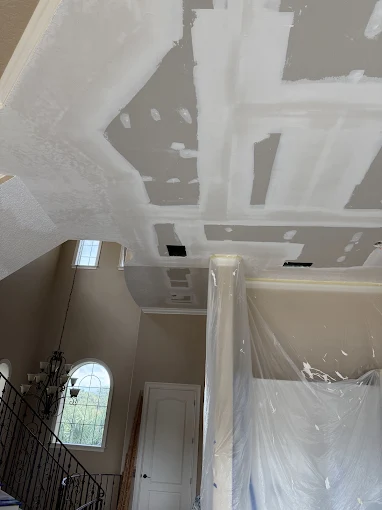
From there: damaged material is cut out clean to solid edges, new drywall is fitted and fastened, and on the block homes that means anchoring into furring strips rather than open stud bays, which takes more care to get a flat, secure patch. Joints get taped and mudded in multiple coats, each one drying before the next goes on. Texture gets matched to the surrounding ceiling or wall, whether that’s a knockdown finish common in the older Dunlawton-area homes or the smoother orange-peel texture typical of newer builds. Then it’s primed and ready for paint, which either the crew handles as part of the job or hands off cleanly if someone else is doing the painting.
The price moves at a few specific points: how much of the damaged area has to be cut back to reach solid material, how many coats the texture match requires to disappear instead of just blend, and whether the ceiling or wall needs priming and painting beyond the patch itself to look even.
- Identify what needs to go. Walk through the rooms, garage, attic, shed and other storage areas. Separate unwanted furniture, appliances, boxes and household clutter from belongings you intend to keep. This helps establish the actual scope of the job.
- Assess access and handling. A large item near an accessible entrance may be straightforward to remove. Bulky furniture in an attic, heavy appliances or items stored behind other belongings can require more time. Stairs, narrow doorways, limited parking and longer carrying distances can also affect the work.
- Determine the size of the cleanout. Removing a few items from one room differs from emptying a garage or preparing an entire property for new occupants. The amount of material, the number of areas involved and the type of items all influence the workload.
- Discuss the estimate. Describe the items and areas involved, including any access challenges or unusual handling requirements. Photos can help communicate the scope before an estimate is arranged.
Where popcorn ceilings and older texture change the plan
A lot of the 1970s and early 1980s block homes in Port Orange still carry their original popcorn ceiling texture, and anything from before the mid-1980s gets tested before it comes down. That’s not a formality. A positive asbestos test means licensed abatement handles that material, not a scraper and a spray bottle, and that’s true no matter how small the section looks. If the texture tests clear, removal and a smooth or knockdown refinish moves forward as a straightforward job. This comes up often enough in Port Orange’s older stock that it’s worth checking before you set expectations on timeline.
The honest constraint: salt air shortens the clock on exterior-adjacent repairs
Here’s the part that catches people off guard. If the drywall damage is tied to an exterior wall near a window, door, or corner close to the coast-facing side of the house, the repair itself is routine, but whatever finish goes over it won’t hold as long here as it would fifteen miles inland. Salt in the air accelerates paint failure and stucco hairline cracking on the exterior side of that same wall, which means a patch that looks perfect on move-in day can show stress again sooner than a homeowner in Deltona or Port Orange would expect from the identical repair. It’s not a reason to skip proper prep. It’s a reason to not be surprised when the exterior side needs attention again before the interior side does.
What to have ready before you call
Walk the area and note whether the damage is active or old. If it’s a ceiling stain, check whether the source has actually been fixed, not just painted over. If it’s cracking, note whether it’s at a corner, a door head, or running across a flat section, since that tells a lot about the cause before anyone sets foot in the house. If the home is vacant part of the year, have a rough timeline for when someone will be on-site next, since access matters more on seasonal properties than full-time residences. And if the repair is part of a larger renovation, it helps to know that upfront so the drywall work gets sequenced correctly with paint, trim or flooring.
Where this fits into a bigger project or a standalone fix
Some of this work is a single patch after a towel bar pulled out of the wall or a door handle put a hole through it. Some of it is full hang and finish on a room being opened up as part of a renovation. Either way, it’s worth seeing the full scope of drywall repair services across the territory to understand what’s covered, and if you’re weighing this against other work needed on a Port Orange property, the Port Orange property services page lays out what else gets handled in this part of the coast.
- Make a list of unwanted items. Identify the furniture, appliances, boxes and other belongings that need to be removed.
- Check each area. Look through the garage, attic, shed, spare rooms and outdoor storage spaces so the full scope is clear.
- Review access. Note stairs, narrow doorways, gates, parking limitations and obstacles between the items and the pickup location.
- Take photos. Pictures of the largest items and each area can help communicate the amount of material involved.
- Identify special handling needs. Mention unusually heavy items, mixed debris or materials that may require separate disposal arrangements.
- Consider the next stage. If the property needs painting, flooring installation, cleaning or repairs after the cleanout, explain your intended schedule.
Rental and seasonal properties add a scheduling layer
With as many seasonal and investment properties as Port Orange has, drywall repair often gets bundled with a turnover: patching a hole before new tenants move in, fixing ceiling staining found during a pre-season inspection, or repairing a wall ahead of a sale. That work gets scheduled around when the owner or property manager can be reached, not when someone happens to be standing in the house, which matters for a city where a lot of owners are managing property from somewhere else for part of the year.
Next step
If you’ve got a crack, a stain, a hole, or a ceiling that needs attention before paint goes on, call (386) 345-2852 for a free estimate. Bring whatever you’ve noticed about when the damage started and whether it’s still active, and the rest gets sorted out on-site.