
Drywall Repair and Replacement in Sanford, Florida
A house going up in a Sanford block ranch off French Avenue in 1962 got drywall hung over furring strips nailed to concrete block, no stud cavity behind it anywhere on the exterior walls. A house in the historic district a half mile away has plaster over wood lath that predates drywall by decades. A patch that works on one will crack, bulge or fall out on the other, and most of the calls Iron Site gets in Sanford are from someone who already paid for the wrong fix once.
Sanford is not one building stock, it is three stacked next to each other inside a few miles, and the approach to a hole in the wall or a cracked ceiling corner depends on which one you are standing in. Downtown bungalows from the early 1900s need plaster technique, not drywall technique. The block ranches from the 1950s through 1970s need a patch anchored into furring strips, not into a stud that isn’t there. Anything built since the 1990s out toward Lake Mary Boulevard is standard wood frame and behaves the way drywall is supposed to behave everywhere else in the country.
Tell Iron Site which of those three you have, or send a photo, and the crew shows up knowing what they’re patching into before they open a toolbox. Call (386) 345-2852 to get a straight answer on scope before anything gets scheduled.
Why furring-strip walls change the whole repair
In Sanford’s older block neighborhoods, the exterior walls are concrete block with wood furring strips run vertically, and drywall screwed to those strips. There is no cavity behind it the way there is on an interior partition wall. That matters the moment you need to patch a hole larger than a few inches, because a standard drywall patch relies on screwing into framing on all four sides, and on these walls the only framing available is the furring strip itself, usually sixteen or twenty-four inches apart.
Get the patch size wrong relative to where the strips actually are and it will telegraph a crack along the seam within a year, even with good tape and mud work. The crew locates the furring strips first, before cutting anything, and sizes the patch to land solidly on wood rather than floating a piece of drywall between strips and hoping the tape holds it. This is the difference between a repair that disappears and one you can trace with your fingertip in low light six months later.
What actually happens, in order, and where the cost forks
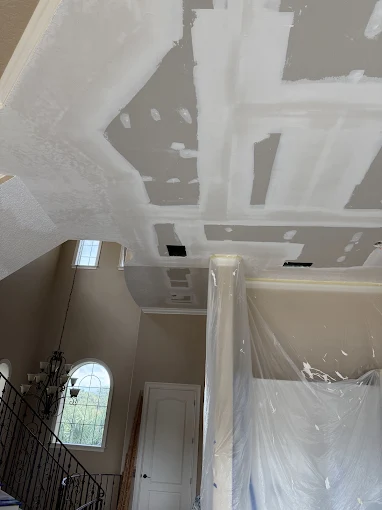
The sequence is the same whether it’s a doorknob hole in a hallway or a full ceiling after a slow leak got fixed by someone else. First is assessment: is this surface damage only, or is there a reason the wall or ceiling failed in the first place. A cracked corner at a door head in a 1970s block ranch is often the house settling on its own slab, which is cosmetic. The same crack pattern radiating from a ceiling stain is a different conversation, and the first question is whether the source of the water has actually been resolved, because no patch holds up under a repeat leak.
Second is cutting back to sound material. Damaged drywall gets removed past the visibly affected area to a point where the surrounding board is solid and dry, and in the furring-strip homes that cut line gets planned around strip locations rather than just squared off. Third is backing and hanging the new piece, taped and mudded in multiple coats with drying time between them. Fourth is texture matching, which is its own skill and the step that separates a patch you can see from one you can’t. Fifth is priming the patched area so it doesn’t flash a different sheen than the rest of the wall once painted.
The cost fork shows up at step one and two. A clean patch in open wall space is straightforward. A repair near a corner, a window return, or spanning multiple furring bays takes longer and costs more because the structural anchoring has to be right, not just the cosmetic finish. Anyone telling you a price before locating the framing is guessing.
- Identify what needs to go. Walk through the rooms, garage, attic, shed and other storage areas. Separate unwanted furniture, appliances, boxes and household clutter from belongings you intend to keep. This helps establish the actual scope of the job.
- Assess access and handling. A large item near an accessible entrance may be straightforward to remove. Bulky furniture in an attic, heavy appliances or items stored behind other belongings can require more time. Stairs, narrow doorways, limited parking and longer carrying distances can also affect the work.
- Determine the size of the cleanout. Removing a few items from one room differs from emptying a garage or preparing an entire property for new occupants. The amount of material, the number of areas involved and the type of items all influence the workload.
- Discuss the estimate. Describe the items and areas involved, including any access challenges or unusual handling requirements. Photos can help communicate the scope before an estimate is arranged.
Texture matching is not optional in a city with this much orange peel and knockdown
Most of Sanford’s housing from the 1960s through the 1980s has orange peel or knockdown ceiling texture, and a lot of walls carry a lighter version of the same finish. A smooth, flat drywall patch dropped into a textured wall or ceiling is the single most common reason a repair looks worse than the damage it fixed. Matching texture means matching the spray pattern, the density, and in some cases the age and slight yellowing of the surrounding surface, not just slapping on the same brand of texture spray from a can.
On ceilings built before the mid 1980s, there’s a separate step before any of this: that popcorn or acoustic texture gets tested before anyone disturbs it. If the test comes back positive, the next call is to a licensed abatement specialist, not a scraper and a patch kit. Iron Site does not remove or disturb material that tests positive, full stop.
The honest constraint: older Sanford walls hide more than they show
Here’s the thing a lot of homeowners don’t expect going in. In the block ranches and the downtown bungalows, pulling off a section of baseboard or cutting into a wall for a repair sometimes exposes something that isn’t drywall damage at all. Subterranean termite activity is common enough in Seminole County’s older housing stock that finding evidence of it behind a wall isn’t rare, and in the frame construction downtown, wood that’s been through a century of Florida humidity can be softer than it looks from the outside.
When that happens, the drywall work pauses on that section and you get told exactly what was found, with photos, before anything gets closed back up. It is slower and sometimes more expensive than a repair that was supposed to be a one-afternoon patch job, and the honest answer is that this is more common in Sanford’s older neighborhoods than in the newer construction out toward the 417. Better to find out now than to have it covered over.
Downtown's historic district plays by different rules for exterior work
Sanford’s residential historic district, the bungalows and frame houses roughly dating from 1900 to 1925, falls under review by the Historic Preservation Board for anything that changes the exterior. Interior drywall repair and texture matching are not exterior changes and don’t trigger that review. But if a drywall job is part of a larger scope that touches siding, trim profiles, or an opening on the street-facing elevation, that piece goes in front of the board before work starts, and the timeline on that review is not something Iron Site controls.
If you’re in one of these houses and the plaster-over-lath construction is part of the picture, say so when you call, because the technique for repairing plaster is different from drywall technique even when the finished look is the same.
What to look at before you call
Walk the area with a flashlight held at a low angle against the wall or ceiling, which shows texture and surface irregularity far better than overhead light does. Note whether the damage is isolated or whether you can see smaller cracks or stains branching out from it, since that tells you whether this is cosmetic or a symptom of something still active. If it’s a ceiling stain, confirm the leak that caused it has actually been repaired, by a licensed plumber or roofer as applicable, because patching drywall over an active leak is wasted work. And know roughly which of Sanford’s three building eras your house falls into, since that single fact changes the repair method more than anything else on this page.
You can see what the full scope of this work covers, from small patches to a full hang-and-finish on a renovation, on the full drywall repair and replacement service page, and if drywall is one piece of a larger project, everything Iron Site handles in Sanford is laid out in one place.
- Make a list of unwanted items. Identify the furniture, appliances, boxes and other belongings that need to be removed.
- Check each area. Look through the garage, attic, shed, spare rooms and outdoor storage spaces so the full scope is clear.
- Review access. Note stairs, narrow doorways, gates, parking limitations and obstacles between the items and the pickup location.
- Take photos. Pictures of the largest items and each area can help communicate the amount of material involved.
- Identify special handling needs. Mention unusually heavy items, mixed debris or materials that may require separate disposal arrangements.
- Consider the next stage. If the property needs painting, flooring installation, cleaning or repairs after the cleanout, explain your intended schedule.
Rental turnovers add their own timeline pressure
Sanford has one of the higher concentrations of small investor-owned rental property in the area Iron Site serves, driven in part by Seminole State College and the SunRail stop pulling in a steady tenant pool. For landlords and property managers, a wall full of nail holes, a cracked corner from a moved piece of furniture, or a scuffed and dented stretch of hallway between tenants is a scheduling problem as much as a repair problem. The faster that unit turns, the less vacancy it sits in.
Drywall repair on a turnover gets handled the same way as any other repair technically, with the same attention to texture matching and anchoring, but it gets scheduled against a move-out and move-in date rather than open-ended. If you manage more than one unit in Sanford, it’s worth asking about getting repairs grouped so the crew is working in one building or one complex in a single visit instead of four separate trips.
Whether it’s a single patch in a Lake Mary Boulevard-area ranch, a ceiling repair after someone else fixed the leak above it, or a full hang-and-finish on a renovation downtown, the first step is the same: describe what’s wrong and roughly how old the house is, and get a plan before anyone shows up with a putty knife. Call Iron Site Property Services at (386) 345-2852 for a free estimate on drywall repair in Sanford.