
Interior Painting in Oviedo, Florida
Most of Oviedo went up fast between the mid 1990s and the late 2000s, which means the builder-grade walls in Alafaya Woods, Twin Rivers and Kingsbridge are now old enough to show it but young enough that nobody expected to be dealing with it yet. The paint in these houses has usually been touched up in spots for twenty years rather than redone, and the person calling about it is often the original owner looking at a living room that’s never matched since a drywall patch in 2011, or a landlord getting a rental ready between UCF leases.
Interior painting here is less about color and almost entirely about what’s underneath the color: nail pops along the drywall seams, hairline cracks where the house has settled, scuffed baseboards, and in a lot of these homes, a textured ceiling that can’t just be rolled over. The prep work is the job. The paint is what you see at the end of it.
If you’re looking at a house from this era and wondering why a repaint quote has so many line items in it, the next few sections walk through exactly what drives that, in the order the work actually happens.
Call (386) 345-2852 and tell us the age of the house and whether the ceilings have texture, and we’ll scope the visit from there.
What a Twenty-Year-Old Oviedo Interior Actually Needs
A house built in 1998 or 2003 isn’t old by Florida standards, but twenty-plus years of air conditioning cycles, humidity swings and settling has done real work on the walls. Drywall seams separate slightly at the tape. Nail heads pop through the texture as framing moves. Corner bead dents from two decades of moved furniture and kids’ bikes. None of this is damage in any dramatic sense, it’s just what happens, but every one of those spots has to be found, filled, sanded and primed before a wall takes paint evenly.
The other thing that shows up constantly in this age bracket is mismatched touch-up paint. Someone patched a hole in 2015 with whatever can was in the garage, and it’s a slightly different sheen or shade than the rest of the wall. A full repaint covers that, but it means the prep has to account for different paint chemistries on the same wall, which affects how many coats it actually takes to get even coverage.
Popcorn Ceilings and What Has to Happen Before Paint Goes On
A lot of Oviedo’s early-to-mid 90s stock still carries the popcorn texture that was standard on Central Florida ceilings into that decade, and it’s the single biggest variable on an interior painting quote in this city. You cannot just roll paint onto popcorn texture and expect it to hold up, and more importantly, if the house was built before the mid 1980s the texture has to be tested for asbestos before anyone touches it. Most Oviedo homes fall after that cutoff, but older pockets of the city and some remodeled sections of older county housing don’t, and we’re not going to guess.
If the test comes back clean, the texture can be removed and the ceiling skim-coated smooth, which is the finish most buyers and renters expect now, or it can be left in place and painted as-is for a lower-cost option. If a test ever comes back positive, that’s licensed abatement work, not something handled with a scraper and a garden sprayer, and we’ll tell you plainly if that’s what you’re looking at before any painting scope gets written.
- Inspect the surfaces. Walls, ceilings, trim, doors and cabinets being painted in place are checked for peeling paint, cracks, stains and previous repairs. This inspection helps determine the preparation required.
- Protect the home. Furniture and belongings are moved away from work areas where possible. Floors, fixtures and surfaces that are not being painted are protected. In occupied homes, the work can be organized around access to essential rooms.
- Repair and prepare. Minor drywall damage and nail holes are patched and sanded. Gaps around trim are caulked where appropriate, and stains may require a stain-blocking primer. Bare and repaired areas are primed as needed to support an even finish.
- Apply the paint. The crew paints the agreed surfaces, including walls, ceilings, trim, doors and cabinets in place. Clean lines around ceilings, corners and trim require careful preparation and application.
- Inspect the finish. Painted areas are checked for missed spots, uneven coverage and visible defects that need attention before the space is put back into use.
Trim, Doors and Cabinets: Deciding What's Actually Included
Builder-grade trim and doors from this era are usually still structurally fine, just worn: scuffed baseboards, chipped paint at door edges, hinges that have picked up grime over the years. Painting trim is a different process than painting walls. It needs a harder-wearing finish, it shows every brush mark if it’s rushed, and doors in particular often come off their hinges and get laid flat to spray cleanly rather than brushed in place.
Cabinets are the other decision point. A lot of these houses still have their original builder cabinets, and painting them in place, rather than replacing them, is one of the more cost-effective updates available in a house this age. It’s also one of the easiest things to underestimate, since it requires degreasing, scuffing or deglossing, and a bonding primer that holds up to daily use. If cabinets are part of the scope, that gets priced and scheduled as its own piece of the job.
The Constraint Most People Don't Expect
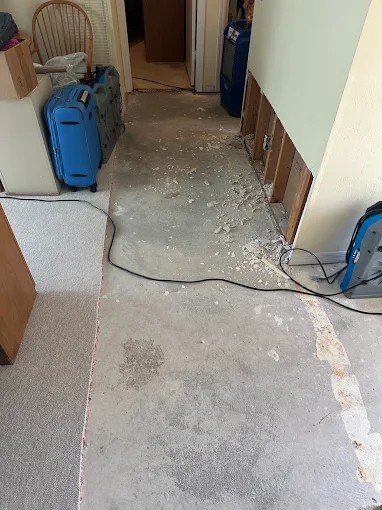
The part that catches people off guard in a house this age isn’t the painting itself, it’s what the drywall and trim removal sometimes reveal. Pulling baseboard in an Oviedo house from the late 90s or early 2000s occasionally turns up old termite damage, either active or long since treated, especially along exterior walls where moisture has worked its way in over the years. When that happens, the honest move is to stop, show you what’s there, and let you decide how to handle it before any paint goes near it. It’s not common, but it’s common enough in houses this age that it’s worth expecting rather than being surprised by.
What to Check Before You Call
Walk the house before you pick up the phone. Look up at every ceiling for texture, water staining, or sagging, since that changes the scope more than anything else. Run a hand along baseboards and door frames for soft spots or separation. Note which rooms have had touch-up paint that doesn’t quite match, and decide now whether cabinets are part of what you want done, since that’s the kind of thing that’s easier to plan for up front than to add halfway through. If you’re a landlord working a turnover between leases, know your move-in date, since that drives the schedule more than anything else on the job.
Our interior painting crews handle the full scope from patching through final coat, and if you want to see the rest of what we handle for homeowners and landlords around town, the property services in Oviedo page covers the rest of it.
Rental Turnovers on an Academic Calendar
With UCF close enough to pull a real share of Oviedo’s rental stock, a lot of interior painting work here runs on a lease calendar instead of a homeowner’s schedule. Units need to turn between a May move-out and an August move-in, or between fall and spring semesters, which means the window is fixed and the work has to fit it rather than the other way around. That’s a different kind of job than an occupied family home: faster access, no furniture to work around, but less flexibility on the date it has to be done by.
Walls that need more than paint? See drywall repair in Oviedo for cracks, holes and ceiling stains.
Call (386) 345-2852 for a free estimate on your interior painting project. Tell us the age of the house, whether the ceilings are textured, and what rooms you’re starting with, and we’ll walk you through what the job actually involves before any work begins.