
LVP and Vinyl Plank Flooring Installation in Port Orange, Florida
Port Orange split its housing in two generations and the split matters for a floor. The block homes from the 1970s and 1980s near Dunlawton have forty-plus years of slab underneath whatever is down there now, often tile or sheet vinyl laid over bare concrete with no vapor barrier. The newer construction in Spruce Creek and Port Orange Plantation sits on slabs poured to a more recent standard, but a lot of those homes are seasonal, owned by someone who is here half the year and gone the other half, which changes how that slab behaves when the air conditioning gets shut off for months at a time.
Vinyl plank is the right floor for both situations, but only if the slab underneath it gets read correctly first. A plank job that skips that step shows up as cupping, lifting seams, or a smell within a year, and by then the floor has to come back up.
Whether the house is original block near the beachside end of town or ten years old in a Plantation subdivision, start with a moisture check on the slab and build the job from there. Call (386) 345-2852 to get a time on the calendar for a walkthrough.
What's actually under the floor right now
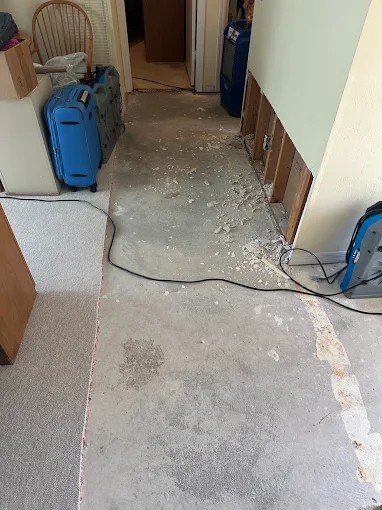
In the older block stock, the most common finds are ceramic tile set directly on the slab, sheet vinyl glued down decades ago, or in some of the original 1970s builds, terrazzo that has been carpeted or tiled over since. Pulling up carpet and tack strip is the fast, cheap version of this job. Pulling up thinset and ceramic, or scraping decades-old vinyl adhesive off bare concrete, is slower and it is usually the larger half of the total cost, not the plank itself. The newer homes in Spruce Creek and the Plantation side tend to have simpler subfloors, often just carpet pad or a single layer of vinyl, which keeps that part of the job shorter and the cost lower.
Why the slab gets tested before anything is ordered
Central Florida slabs take on and give off moisture year round, and a meaningful share of what was poured here before the 1990s has no vapor barrier under it at all. Port Orange adds its own wrinkle on top of that: a real portion of the housing stock here is occupied seasonally, which means the slab spends stretches of the year without air conditioning running over it to keep the interior air dry. A slab that reads fine in a house that’s been lived in and conditioned continuously can read differently in a place that just got reopened for the season. That reading is what decides whether the job needs a moisture mitigation step before a single plank goes down, and it is not a step worth skipping to save a day.
Flatness is the other half of the equation
Vinyl plank is thin and it is unforgiving. Any dip, ridge, or old patch in the slab telegraphs straight through the surface within a few weeks of foot traffic, and it will show up as a visible low spot or, worse, a spot where the locking seams start to separate. Self-leveling compound in the low areas and grinding down the high ones is part of the prep, not an upsell, and it is more likely to be needed in a 1970s or 1980s block home where the original pour was never perfectly flat to begin with.
Glue-down versus floating click-lock
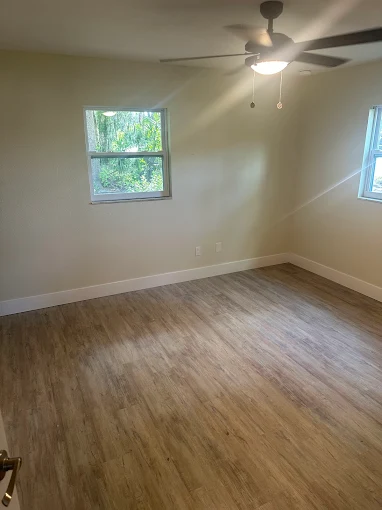
Floating click-lock plank is the faster, less invasive install and it works well over most flat, dry concrete, tile, or terrazzo. Glue-down gets used where there’s unusual slab irregularity that needs the adhesive to help stabilize the plank, or in larger open rooms where a floating floor’s expansion needs more careful management. Either way, baseboard and shoe molding come off and get reset, doors get undercut so they swing freely over the new thickness, and transition strips go in at every doorway and change of flooring. None of that is a line item tacked on at the end. It is the job.
For rentals and seasonal properties
Port Orange has a heavy retiree and seasonal ownership share, and that means a steady run of properties that need to be ready for a tenant or a returning owner on a set date, not whenever it’s convenient. Wear layer thickness is the spec that matters most here. A floor that will see a new tenant moving furniture in and out every year or two needs a thicker wear layer than one going into an owner-occupied home, because that layer is what resists scuffing, gouging, and the general wear of furniture drag over time. It costs more up front and it is the right call for anything that turns over.
The honest constraint
What usually surprises people in Port Orange is not the plank itself, it’s what comes off the floor before the plank goes on. A house near Dunlawton with original ceramic tile or old sheet vinyl glued straight to the slab takes real time and labor to remove cleanly, and that demolition and prep can run longer than the installation that follows it. Anyone pricing this job off a square footage number alone, without someone looking at what’s currently on the floor, is pricing a different job than the one that actually happens.
- Existing flooring: Identify whether the rooms have carpet, ceramic tile, sheet vinyl, terrazzo, or multiple materials.
- Room measurements: Estimate the length and width of each area you want to update.
- Visible concerns: Note cracks, uneven surfaces, dampness, or flooring that has lifted or shifted.
- Trim and doorways: Check the condition of your baseboards and identify where transitions may be required.
- Flooring selection: If you have chosen a product, keep its installation method, wear layer specifications, and moisture requirements available.
- Other renovations: Mention any planned painting, cabinet updates, or interior work that could affect the installation schedule.
What to have ready before you call
Know what’s currently on the floor: carpet, tile, sheet vinyl, or exposed terrazzo. Note whether the house has sat closed up for any stretch recently, since that affects what the slab reading is likely to show. Measure the square footage of the rooms involved as closely as you can, and if the property is a rental or seasonal unit, have a target move-in or turnover date in mind so the schedule can be built around it. A full look at vinyl plank flooring installation covers the material side of this in more depth, and the broader range of property services in Port Orange is worth a look if the floor is one piece of a larger turnover or renovation.
Next step
Bring a photo or two of the existing floor and a sense of your timeline, and the walkthrough will cover the rest, including the slab reading that decides how the job actually gets scoped. Call (386) 345-2852 to set up a time.