
Popcorn Ceiling Removal and Ceiling Repair in Volusia and Seminole Counties
The popcorn on your ceiling has yellowed, sheds into the corners, and holds dust and cobwebs that never quite come off. You want a flat, clean ceiling without losing a week of your house to it. Before anyone puts a scraper to it, a few things about Central Florida ceilings decide how the job goes and what it costs.
The short version
- Texture in a house built before the mid 1980s gets tested before it comes down.
- A positive test means licensed abatement. It does not mean a scraper and a spray bottle.
- Scraping is the quick part. Repairing and refinishing the ceiling underneath is where the work is.
- The finish you pick (knockdown, orange peel or smooth) moves the price more than almost anything else.
- Water stains mean finding the leak first. The ceiling gets repaired after it is fixed.
- Photos of the ceiling and the year the house was built make the estimate faster and more accurate.
The short version
- Walk-through and testing. We look at the ceiling in person, check the condition of the drywall, and ask when the house was built. If it dates from before the mid 1980s, a sample of the texture goes to a lab before any work starts. Nothing is scraped, sanded or disturbed until the result is back.
- Prep. Furniture comes out of the room or moves to the center under plastic. Floors, walls, doors and built-ins get covered. Light fixtures and ceiling fans have to be down before texture work begins. Anything involving wiring belongs to an electrician, and we schedule around that.
- Texture removal. On an unpainted ceiling the texture is wetted so it softens, then scraped off. A painted ceiling takes longer because the paint seals the texture and keeps water out. Scraping done carelessly gouges the drywall paper, so it is slow, controlled work.
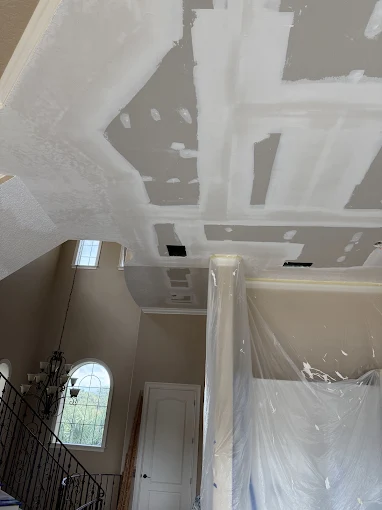
- Ceiling repair. This step is the reason to hire experienced painters and drywall finishers. Once the texture is off, every flaw it was hiding shows: loose or bare tape seams, nail pops, gouges, old patches, cracks along the wall line. These get taped, coated and sanded smooth.
- Finish coats. Depending on the finish you chose, the ceiling gets a skim coat for a smooth surface or a fresh spray or hand-applied texture such as knockdown or orange peel. Joint compound needs time to dry between coats, and that drying time is most of the schedule.
- Prime and paint. A primer that seals the new surface goes on first, then ceiling paint. Skipping the primer is why some ceilings look blotchy after painting.
- Cleanup. Plastic comes down, debris is hauled out, and floors and surfaces are cleaned before we hand the room back.
What moves the price
- Test result. This comes before everything else. If the texture tests positive, the job is no longer ours to scrape, and the plan changes.
- Finish you choose. A knockdown or orange peel texture hides small imperfections. A smooth ceiling hides nothing, so it needs more skim coats and more sanding, and it costs more because the labor is mostly finishing.
- Whether the ceiling is painted. Painted popcorn resists water, so it takes more time and more care to remove cleanly.
- Size, height and layout. Vaulted ceilings, stairwells and open great rooms need staging and take longer than a standard eight or nine foot bedroom.
- How many rooms, and how empty they are. A cleared room goes faster than one that has to be worked around.
- Existing damage. Cracks, old patches, nail pops, holes from removed fixtures, and stains all add repair time.
- Paint. Ceiling paint is part of the finished job. If walls will be painted at the same time, it is more efficient to do it all in one visit.
What is different about doing this in Central Florida
- Most ceilings here hang under roof trusses. Trusses move with temperature and humidity, and the drywall at the wall-to-ceiling joint often shows it as a hairline crack that returns. When we finish the ceiling, we treat that joint with this in mind rather than assuming one pass of tape will hold forever.
- Block construction changes the room around the ceiling. In a concrete block house with furred and drywalled exterior walls, the ceiling meets the wall in a different way than it does in a stick-framed house. Cracks at that corner behave differently, and the repair method needs to account for it.
- Humidity controls the schedule. Joint compound dries slowly in a Florida summer if the air conditioning is not running. A ceiling coated and primed too early traps moisture and shows ghosting or cracks later. We plan drying time into the job and ask that the AC stay on and the house stay closed up.
- The age of the stock varies widely. Across Volusia and Seminole, houses range from the 1960s and 1970s in parts of Deltona, Orange City and Sanford, to 1980s and 1990s neighborhoods around Lake Mary, Winter Springs, Oviedo and Port Orange. The older the house, the more likely testing matters, and the more likely the ceiling has been repainted over several times.
- Sliders, lanais and soffits. Texture on a lanai ceiling or covered entry gets more sun, moisture and mildew than interior texture, and it ages differently. If it is part of the job, tell us when we meet so we can look at it.
- Smoke and nicotine stains bleed through ordinary paint. A stain-blocking primer is part of the plan for any ceiling that shows tan or yellow staining.
What most people have wrong
Many people expect that once the popcorn comes off, a smooth, finished ceiling is underneath. Often it is not. Builders commonly sprayed texture on ceilings because it hid taped seams and drywall work that was never finished smooth. When the texture comes off, those seams, screw heads and uneven spots are right there to be seen.
That is why scraping alone gives a rough, patchy ceiling that needs skim coating or new texture to look right. It is also why a quote for “popcorn removal” that does not mention repair or refinishing is only describing part of the job. Ask what the ceiling will look like when the work is done, not just whether the texture will be gone.
What to have ready before the estimate
- The approximate year the house was built, and whether the ceilings have ever been painted.
- A few photos of the ceiling, including any stains, cracks or sagging, and a wide shot of each room.
- A list of the rooms you want done, and which ones have vaulted or high ceilings.
- Any light fixtures or ceiling fans in the way, and whether wiring needs to change.
- The finish you are leaning toward: smooth, knockdown or orange peel.
- Any past leaks, and whether they have been fixed. If a stain is still active, the leak comes first.
- Any HOA requirements, in case they apply to the work.
Where we do this work
Next step
Send us photos of your ceilings and the year the house was built, or call to set up a free estimate. We will walk the rooms, tell you what we see, and lay out the steps and the decisions that affect the price.