
LVP and Vinyl Plank Flooring Installation in Longwood, Florida
Longwood has the most mismatched housing stock in the area the flooring crew covers. A hundred-year-old frame house near the historic district by the Longwood Hotel sits a few miles from a 1978 custom home in Sweetwater or Wekiva Springs with a sunken living room and original terrazzo under the carpet. Neither one behaves like a newer slab, and the people calling about vinyl plank in this city are usually the ones who pulled up a corner of carpet and found something they weren’t expecting.
That’s the real starting point for this job. Vinyl plank itself is a straightforward material, click-lock or glue-down, wear layer rated for a rental or rated for a family that’s going to live on it for years. What makes the installation easy or hard, fast or slow, cheap or expensive, is entirely what’s underneath it and what has to come off first. In a Longwood home that could be decades-old sheet vinyl over the original subfloor, ceramic tile set in a thick mortar bed with its own built-in slope, or a slab of terrazzo nobody’s seen in full since the Carter administration.
Before any of that gets decided, the slab gets checked for moisture and the surface gets checked for flat. Skip either step and the plank either fails early or every low spot and seam in what used to be down there shows up as a visible flaw in the new floor. Get a free look at the room in question and a real answer on what’s involved before you commit to a direction.
What comes up before anything goes down
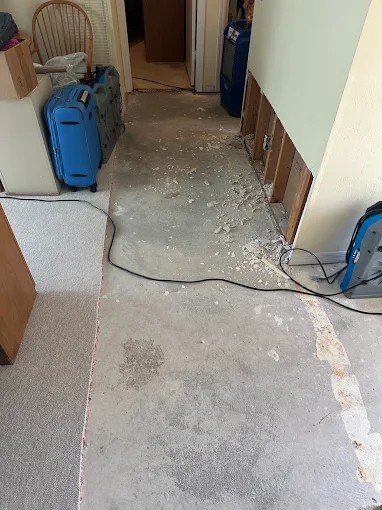
In most Longwood homes built from the 1960s through the early 1980s, removal is the bigger half of the job, not an afterthought before it. Carpet and tack strip is the easy case. Sheet vinyl, especially layered sheet vinyl from a previous renovation, takes longer because the adhesive underneath has had forty years to cure into the subfloor. Ceramic tile has to be chipped or ground off, and in the Sweetwater and Wekiva Springs custom homes it’s frequently set thick enough that what’s left after removal is uneven and needs a leveling compound before plank can go over it at all.
Then there’s terrazzo, which shows up more in Longwood’s older custom-built stock than almost anywhere else in the service area. Terrazzo is flat, hard, and in most cases a perfectly good base for vinyl plank once it’s cleaned and primed correctly. It’s also heavy, cold underfoot, and often original to a sunken living room step-down that creates a transition problem the flooring crew has to plan for, not react to on install day.
The slab moisture question this soil and this age of house makes unavoidable
Central Florida slabs take on and release moisture year-round, and a meaningful share of what went up in the Wekiva and Sweetwater subdivisions in the 1970s and early 1980s was poured with no vapor barrier underneath at all. That’s the single condition most likely to ruin a vinyl plank installation here, because moisture pushing up through a slab with no barrier will loosen adhesive, cup planks, or create a mildew smell under a floating floor within a year or two of what looked like a clean job.
The slab gets tested before flooring goes over it, not after a floor starts failing. If the reading comes back high, that changes the adhesive system, the underlayment, or in some cases means a moisture mitigation coating goes down first. It’s an extra step, and it’s the step that decides whether the floor lasts.
What drives the price up or down
Four things move the cost of a Longwood vinyl plank job, in the order they get decided. First, what’s coming up: carpet is cheap and fast, tile and terrazzo removal take longer and generate more debris to haul off. Second, what the slab or subfloor needs once that’s gone, whether that’s a simple clean and prime or grinding down mortar high spots and running leveling compound across the room. Third, the moisture reading, which determines the underlayment and adhesive approach. Fourth, square footage and layout complexity, including how many transitions, closets, and doorway undercuts the room requires.
Baseboard and shoe molding removal and reset, door bottom trimming so doors clear the new floor height, and transition strips between rooms are part of the installation scope, not line items added after the fact. If old baseboard is too brittle or water-damaged to go back up, that gets flagged before demo, not discovered when it cracks during removal.
What to look at before you call
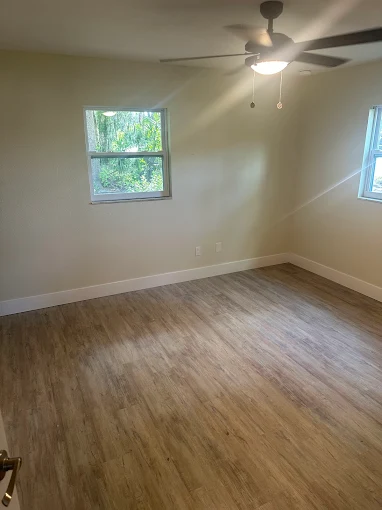
Pull a corner of carpet or pry up a loose tile in an inconspicuous spot if you can do it without damaging anything, and take a look at what’s actually down there. Terrazzo, ceramic, sheet vinyl, and plain concrete all call for a different prep approach, and knowing which one you have before the estimate saves a step. Note any spots where the floor feels soft, where water has visibly pooled in the past, or where a previous repair patch is obviously a different material than the rest of the room. Measure the square footage of each room you’re considering, and have a rough sense of whether you want floating click-lock plank or a glued-down installation, since that choice affects how the subfloor prep gets scoped.
If you’re weighing vinyl plank flooring installation against other flooring across more than one room, or if the floors are one piece of a larger renovation that includes paint, trim, or cabinet work, it’s worth looking at the full range of property services in Longwood rather than treating the floor as an isolated project.
The honest constraint
Older Longwood homes, particularly the Sweetwater and Wekiva custom builds with sunken rooms and original terrazzo, routinely take longer to prep than a comparable job in a newer subdivision closer to the highway. A sunken living room step creates a height transition that has to be engineered into the plank layout, not patched over. A slab with no vapor barrier might need a mitigation step a 1995 slab doesn’t. None of that is optional, and skipping it to save a day of labor is exactly how a floor that looked fine on install day fails eighteen months later.
- Existing flooring: Identify whether the rooms have carpet, ceramic tile, sheet vinyl, terrazzo, or multiple materials.
- Room measurements: Estimate the length and width of each area you want to update.
- Visible concerns: Note cracks, uneven surfaces, dampness, or flooring that has lifted or shifted.
- Trim and doorways: Check the condition of your baseboards and identify where transitions may be required.
- Flooring selection: If you have chosen a product, keep its installation method, wear layer specifications, and moisture requirements available.
- Other renovations: Mention any planned painting, cabinet updates, or interior work that could affect the installation schedule.